Context Engineering: The Art of Feeding the Model What It Actually Needs
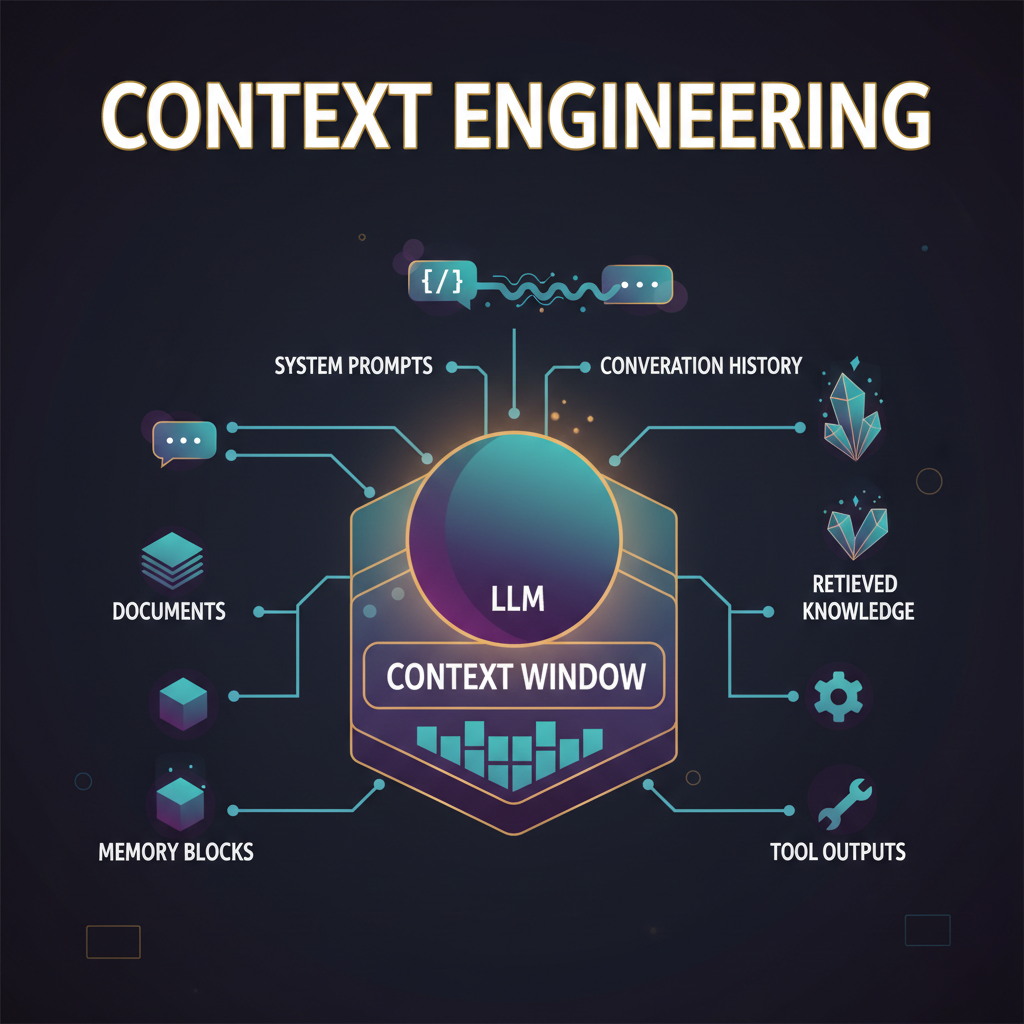
There's a growing consensus among practitioners building serious LLM applications: the highest-leverage work isn't tweaking prompts or fine-tuning weights. It's deciding what information the model sees at the moment it generates a response. This discipline is called Context Engineering, and it's quietly becoming the most important skill in applied AI.
If prompt engineering is about phrasing the question well, context engineering is about assembling the entire briefing packet that surrounds that question.
Defining Context Engineering
Context Engineering is the practice of dynamically assembling the right information, in the right format, within the model's context window, so it can produce accurate and relevant outputs.
The context window is finite and precious. Every token you spend on irrelevant information is a token you can't spend on what matters — and worse, noise actively degrades performance. Context engineering is the systematic effort to fill that window with signal.
A model's output is only ever as good as the context it's given. Garbage in, garbage out has never been more literal.
What Lives in the Context Window?
At inference time, the context window is a carefully composed stack of ingredients:
- System instructions — the model's role, rules, and behavioral guardrails.
- Retrieved knowledge — documents and facts pulled from a knowledge base (RAG).
- Conversation history — prior turns, often compressed or summarized.
- Memory — durable facts about the user or task carried across sessions.
- Tool outputs — results from API calls, database queries, or code execution.
- The current query — what the user actually asked.
The engineering challenge is that these sources compete for limited space, and their relevance changes with every single request.
Why It's Hard: The Constraints
1. The Context Window Is Finite
Even large windows fill up fast when you're stuffing in documents, history, and tool results. You must budget tokens deliberately, deciding what earns a place and what gets cut.
2. More Context Isn't Always Better
Research on the "lost in the middle" phenomenon shows that models attend most strongly to information at the beginning and end of their context, and can overlook details buried in the middle. Dumping everything in doesn't help — placement and pruning matter enormously.
3. Relevance Is Dynamic
The right context for "What's my refund status?" is completely different from "How do I reset my password?" Context must be assembled per-request, not baked in statically.
Core Techniques of Context Engineering
Retrieval-Augmented Generation (RAG)
RAG fetches relevant chunks from an external knowledge base and injects them into the context. The quality of a RAG system depends far more on retrieval quality than on the model.
def build_context(query: str) -> str:
    chunks = vector_store.search(query, top_k=5)
    ranked = rerank(query, chunks)          # push the best to the edges
    return format_context(ranked[:3])        # budget: only the top 3
Compression and Summarization
Long conversation histories can be summarized into compact representations that preserve meaning while freeing tokens. Instead of 40 verbose turns, you carry a tight running summary plus the last few exchanges verbatim.
Structured Formatting
How you present context matters as much as what you present. Well-delimited sections, consistent labels, and clear hierarchy help the model parse the input.
## USER PROFILE
Name: Alex | Plan: Pro | Region: EU

## RELEVANT DOCS
[1] Refunds are processed within 5 business days...
[2] Pro plans are eligible for prorated refunds...

## CURRENT QUESTION
When will I get my refund?
Structure reduces ambiguity and makes the model's job easier.
Context Prioritization
Given a token budget, rank sources by importance and place the most critical information where the model attends best — near the top and bottom of the window.
| Priority | Content | Placement |
|---|---|---|
| High | System rules, current query | Top & bottom |
| Medium | Top retrieved documents | Upper-middle |
| Low | Background / older history | Compressed summary |
Context Engineering vs. Prompt Engineering
Prompt engineering optimizes a static string of instructions. Context engineering optimizes a dynamic pipeline that constructs the model's entire working memory on the fly.
Think of it this way: a prompt is a single sentence you say to a colleague. Context is the folder of documents, the meeting notes, and the shared history you hand them first. A brilliant question asked with no context yields a mediocre answer. A modest question asked with perfect context yields a great one.
A Mental Model: The Model as a New Employee
Imagine hiring a brilliant but amnesiac expert. They forget everything between conversations. To get good work out of them, you must, every single time:
- Remind them of their role and the rules (system prompt).
- Hand them the relevant reference materials (retrieval).
- Recap what happened previously (memory & history).
- Give them the tools and their latest results (tool outputs).
Context engineering is the craft of preparing that briefing perfectly, every time, automatically.
Practical Principles
- Curate ruthlessly. Relevance beats volume. Cut anything that doesn't earn its tokens.
- Budget your window. Treat tokens as a scarce resource with an explicit allocation.
- Mind the position. Put critical information where the model attends most.
- Format for clarity. Structure and delimiters materially improve comprehension.
- Assemble dynamically. Build context per-request; never rely on one static block.
Conclusion
As models grow more capable, the bottleneck shifts from reasoning to knowing what to reason about. Context Engineering is how you close that gap. It's less glamorous than prompt hacking and less hyped than fine-tuning, but it's where reliable, grounded, genuinely useful AI applications are actually built.
Feed the model well, and it will reward you.