Harness Engineering: Building the Scaffolding That Makes AI Systems Trustworthy
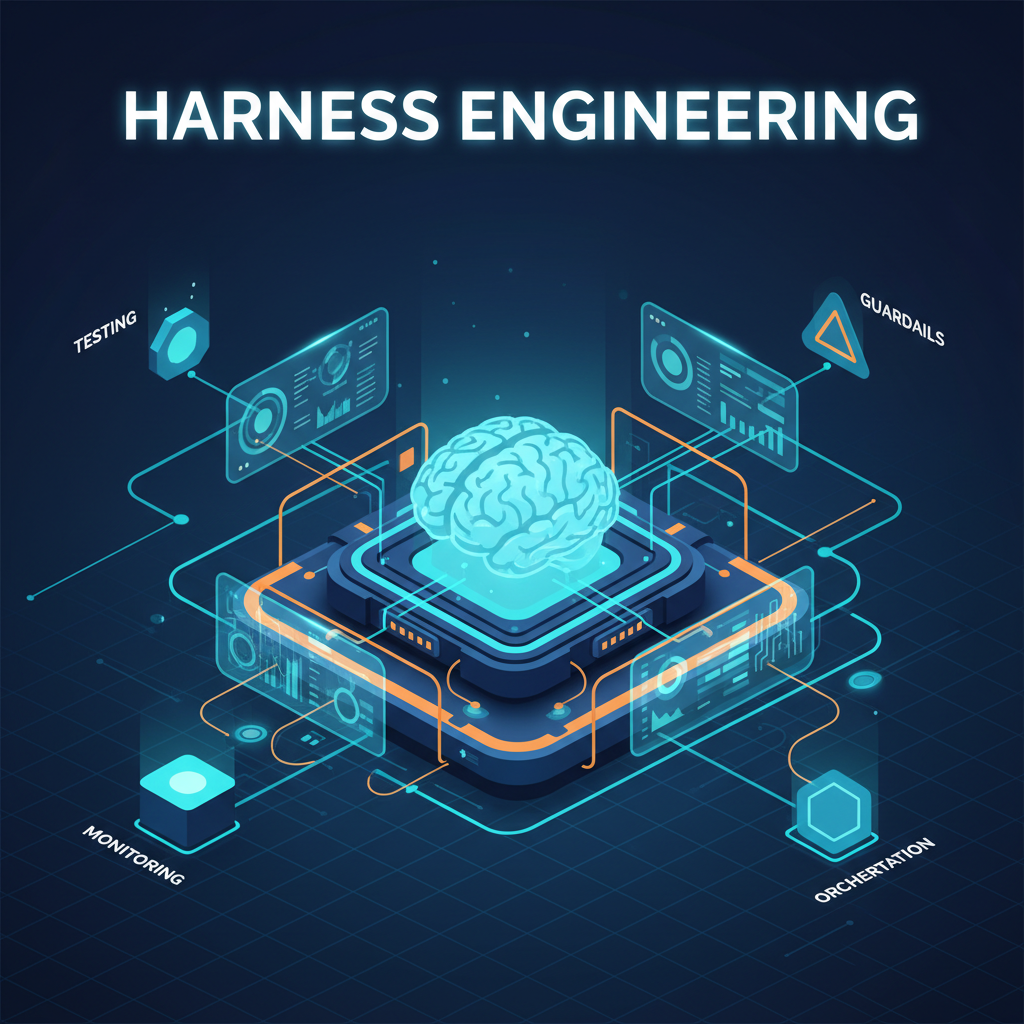
When people talk about AI applications, the conversation usually gravitates toward the model. Which foundation model? How big is the context window? What's the benchmark score? But anyone who has shipped a real AI product to production knows a quiet truth: the model is only a fraction of the work. The other 90% is the harness — the engineered scaffolding around the model that turns a probabilistic text generator into a dependable system.
This discipline of designing, building, and maintaining that scaffolding is what we call Harness Engineering.
What Is a Harness?
A harness is the layer of infrastructure that wraps a model and governs how it is invoked, constrained, evaluated, and improved. If the model is the engine, the harness is the chassis, the safety belts, the dashboard, the brakes, and the diagnostic computer all at once.
A harness typically includes:
- Input shaping — how raw user requests, retrieved data, and tool outputs are assembled before they reach the model.
- Guardrails — validation and safety layers that catch unacceptable inputs and outputs.
- Orchestration — the control flow that decides when to call the model, when to call a tool, and when to retry.
- Evaluation — automated scoring that tells you whether the system is actually getting better or worse.
- Observability — logging, tracing, and monitoring so you can debug non-deterministic behavior.
The key insight is that these components are engineering artifacts, not prompt-tinkering afterthoughts. They deserve the same rigor as any production software.
Why Harness Engineering Matters
Language models are non-deterministic and open-ended. The same prompt can yield different outputs, and a small change upstream can ripple in surprising ways. This breaks many assumptions that traditional software engineering relies on.
Consider a support-automation agent. Without a harness:
- A malformed user message can derail the entire conversation.
- A hallucinated refund amount can go straight to a customer.
- A silent regression after a model upgrade can go unnoticed for weeks.
A well-built harness turns each of these failure modes into a handled case. The value isn't in making the model smarter — it's in making the system predictable enough to trust.
The Core Pillars of a Harness
1. Guardrails
Guardrails enforce boundaries on both sides of the model.
- Input guardrails reject prompt-injection attempts, filter PII, and validate schema.
- Output guardrails verify that responses conform to expected formats, stay on-topic, and don't leak sensitive data.
def output_guardrail(response: dict) -> dict:
    if "refund_amount" in response:
        assert response["refund_amount"] <= MAX_AUTO_REFUND, \
            "Refund exceeds auto-approval limit — escalate to human"
    return response
A good guardrail is fail-loud: when something violates a constraint, the system stops or escalates rather than quietly proceeding.
2. Orchestration
Orchestration is the control flow of your AI system. Should the model answer directly, call a search tool, or ask a clarifying question? Should a failed call be retried, rerouted, or handed to a human?
Modern harnesses often model this as a state machine or a directed graph of steps, where each node is a well-defined operation and edges encode the decision logic. This makes behavior inspectable and testable — a stark contrast to a single monolithic prompt trying to do everything.
3. Evaluation
You cannot improve what you cannot measure. Evaluation harnesses run your system against curated datasets and score the results.
| Evaluation Type | What It Measures | Example |
|---|---|---|
| Golden set | Regression against known-good answers | Fixed Q&A pairs |
| LLM-as-judge | Subjective quality at scale | Helpfulness rating |
| Assertion-based | Hard constraints | Valid JSON, no PII |
| Human review | Ground truth on edge cases | Sampled production traffic |
The discipline here is treating evals like a test suite: they run on every change, and a drop in score blocks the release.
4. Observability
Because failures are subtle and probabilistic, you need deep visibility. Trace every model call, log the full assembled input, capture token usage, and record which branch of orchestration fired. When something goes wrong in production, you want to replay the exact conditions — not guess.
Harness Engineering vs. Prompt Engineering
Prompt engineering asks: "What words should I give the model?"
Harness engineering asks: "What system should surround the model so that it behaves reliably regardless of any single prompt?"
Prompts are brittle and local. Harnesses are durable and systemic. A well-engineered harness lets you swap the underlying model, upgrade a prompt, or add a new tool without the whole system collapsing — because the contracts between components are explicit and tested.
Practical Principles
- Make everything replayable. If you can't reproduce a failure, you can't fix it.
- Fail loud, not silent. Surface violations immediately; never let bad output pass quietly.
- Version everything. Prompts, tool schemas, and eval sets should be versioned like code.
- Automate evaluation. Manual spot-checks don't scale and won't catch regressions.
- Design for model change. Assume you'll swap models. Keep the harness model-agnostic.
Conclusion
The frontier of applied AI is shifting. As foundation models converge in raw capability, the differentiator increasingly isn't which model you use — it's how well you harness it. Harness Engineering is the discipline that separates a flashy demo from a dependable product.
Invest in the scaffolding. That's where reliability lives.